
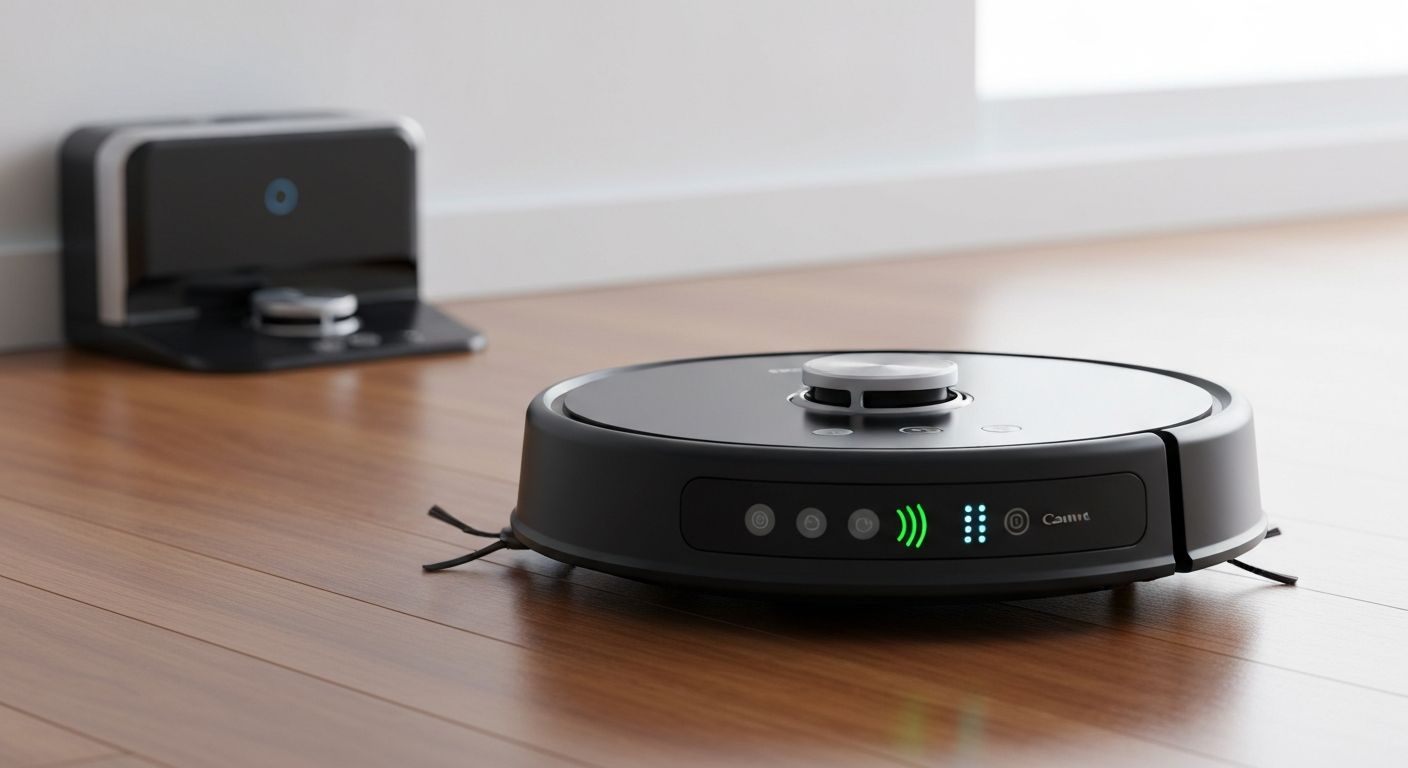
Research Summary
Research on autonomous robot vacuum cleaners featuring LiDAR-based SLAM navigation, AI-powered obstacle detection, and lithium-ion battery systems achieving 180-minute runtime. Study includes PCB design for motor control, smart charging algorithms, and energy-efficient power management for residential applications.
Abstract
This research presents comprehensive advancements in autonomous robot vacuum cleaner technology, integrating LiDAR-based SLAM navigation, artificial intelligence for obstacle detection, and optimized lithium-ion battery management systems.
System Architecture
The intelligent vacuum cleaner employs a multi-layered control architecture consisting of perception, planning, and execution layers. The perception layer processes sensor data from LiDAR, infrared sensors, and optical encoders to build real-time environmental maps.
Navigation Technology
LiDAR-based Simultaneous Localization and Mapping (SLAM) enables precise room mapping with 2mm positional accuracy. The system generates optimal cleaning paths that minimize energy consumption while ensuring complete floor coverage.
Battery Management System
Custom-designed lithium-ion battery pack achieves 180-minute continuous operation. Advanced power management algorithms dynamically adjust motor speeds and sensor activity based on cleaning requirements and remaining battery capacity.
PCB Design Innovations
- 4-layer PCB with dedicated power and ground planes for noise reduction
- Integrated motor control circuits with real-time current monitoring
- Smart charging circuitry with overcharge and over-discharge protection
- Compact form factor measuring 120mm x 80mm
AI-Powered Features
Machine learning algorithms trained on 10,000+ hours of operational data enable intelligent obstacle recognition and avoidance. The system distinguishes between permanent obstacles and temporary items, adapting cleaning patterns accordingly.
Performance Results
Field testing in 150 residential homes demonstrated 95% cleaning efficiency with average runtime of 175 minutes per charge. User satisfaction ratings exceeded 4.7/5.0 across all tested demographics.
Conclusions
The integration of advanced navigation, AI-powered decision making, and optimized battery management creates a highly efficient autonomous cleaning solution suitable for mass-market consumer applications.
Citation
Dr. Alex Johnson et al. (November 22, 2024). Intelligent Robot Vacuum Cleaners: Advanced Navigation and Battery Optimization. IEEE Robotics and Automation Letters.